The way we work
Our
method
We do not replace your engineering tools. We connect the design, the field and operation.
A method outlives a change of tool
What stays true when the software changes
We model in AutoCAD Plant 3D, we check in Navisworks, we survey with a Trimble X7. These tools are good, and they will change. What does not change is the order in which the questions have to be asked.
A contractor who sells a tool ties you to the lifetime of that tool. A method, by contrast, can be handed on, audited and continued with something else. That is what we deliver alongside the drawings.
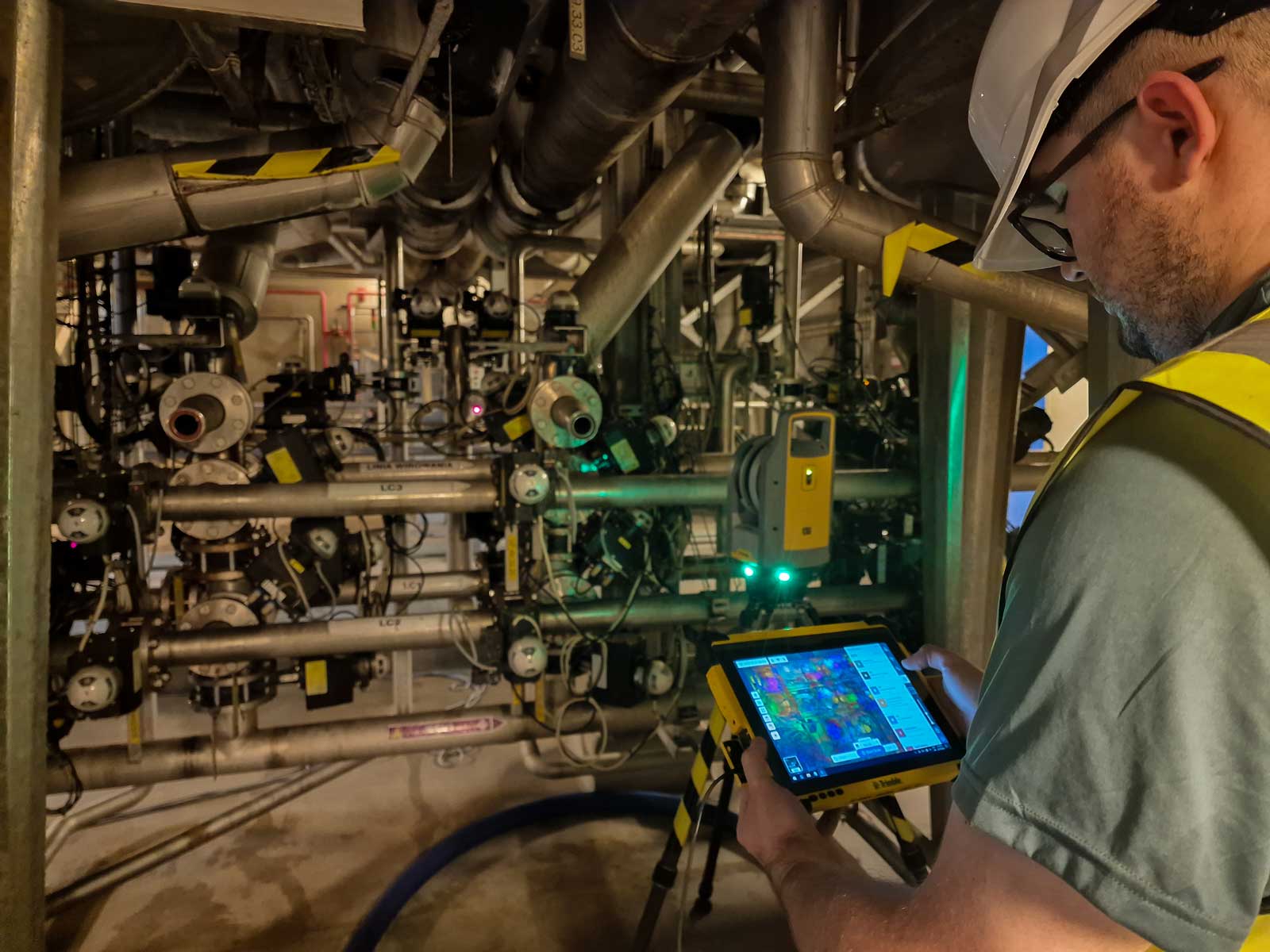
The first rule is never to take a drawing as true without confronting it with the field. A document has a date; an installation has a history, and the two begin to diverge from start-up onwards.
That confrontation is not merely a matter of correcting. It produces a register of discrepancies, which is itself a deliverable: it tells the operator what they did not know about their own plant.
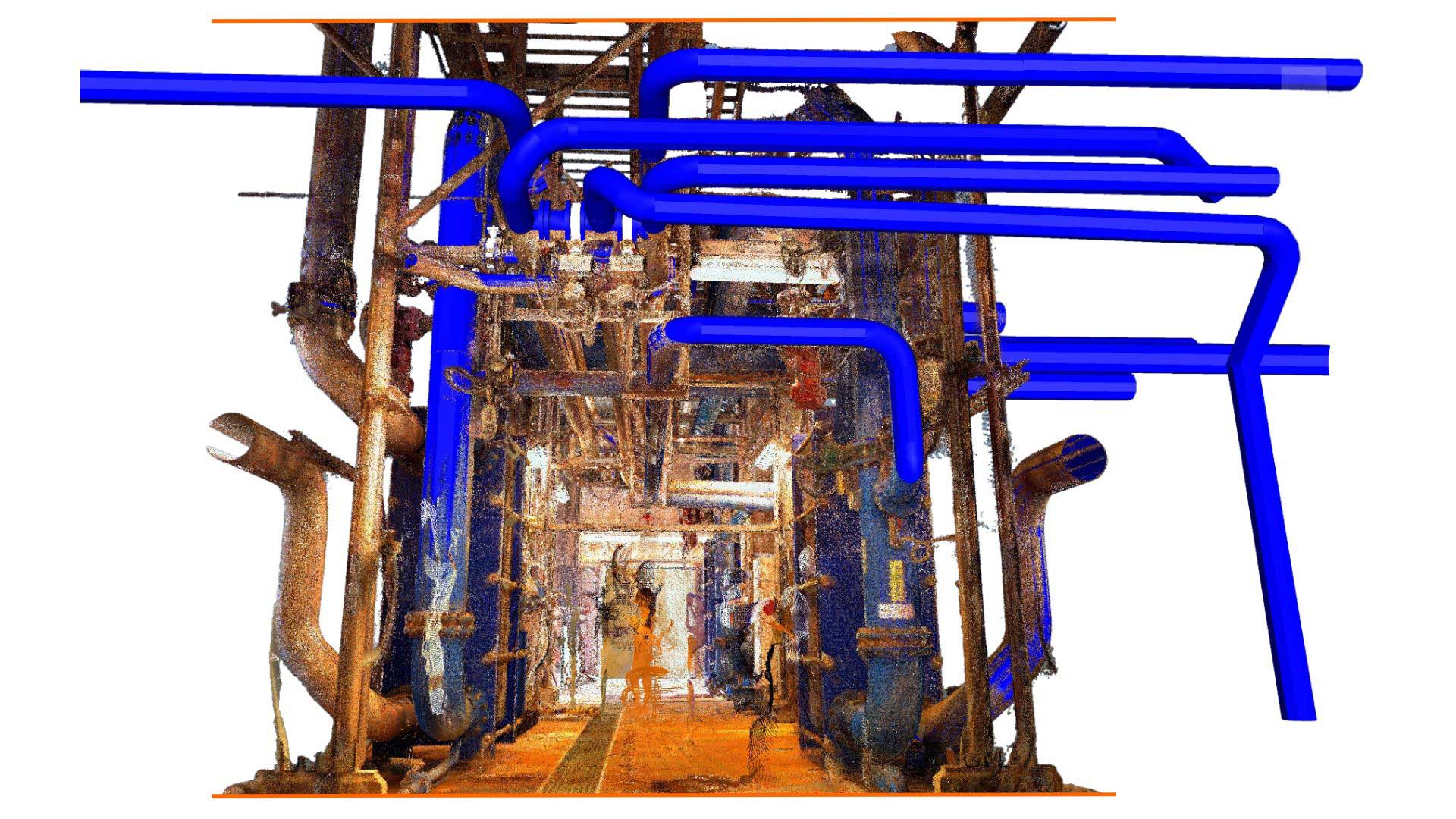
Everything we produce afterwards is built against the point cloud: layout, routing, supports, tie-in points. A clash with the existing plant is therefore settled on screen, where it costs an hour, and not during erection, where it costs a shutdown.
This rule has a commercial consequence we accept: we would rather tell you early that a survey is needed, even if it makes a proposal heavier, than discover late that the design was resting on sand.
The order of the questions
What has to be achieved, and by when
The operating need before the technical solution. Many requests arrive already expressed as a solution; restating them as an objective often reveals a simpler route.
What is really known about the existing plant
An inventory of what is documented, what is assumed and what is unknown. It is that third column which decides the extent of the survey.
What constrains erection
Possible isolations, access, co-activity, shutdown duration. Those constraints steer the design as much as the process does.
What becomes of the dossier after us
Open formats, documents revised in their as-built state, point cloud retained by the client. A design that cannot be picked up again is a design to be done twice.
What we check before delivering
An engineering dossier is judged on what it saves during erection. These six checks are carried out systematically, because they correspond to the six errors a pipe fitter most often discovers once the line is in their hands.
Consistency between P&ID and isometrics
Every line on the diagram is found in the isometrics, with the same tag, the same class and the same diameter. Divergence between those two documents is the first anomaly recorded on site.
Bill of materials extracted from the model
The bill of materials is produced from the model, never re-entered alongside it. A list kept by hand always ends up diverging from the drawing, and it is procurement that finds out.
Clash detection
The model is checked against the surveyed existing plant and against the other trades. We look for hard clashes, but also for access defects: a valve that cannot be operated is a clash, even if nothing touches.
Accessibility for operation
Clearance needed to remove a component, personnel access, headroom under the lines, access to measuring points. These are the omissions that cost most after start-up, because they are paid for every year.
High points, low points and slopes
Vents, drains and drainage slopes are checked on the model. This is typically the detail that only shows up at the first cleaning, when the line does not empty.
Review by an engineer who did not draw it
A fresh eye finds what the author no longer sees. That cross-review is time allowed for in the schedule, not an end-of-project courtesy.
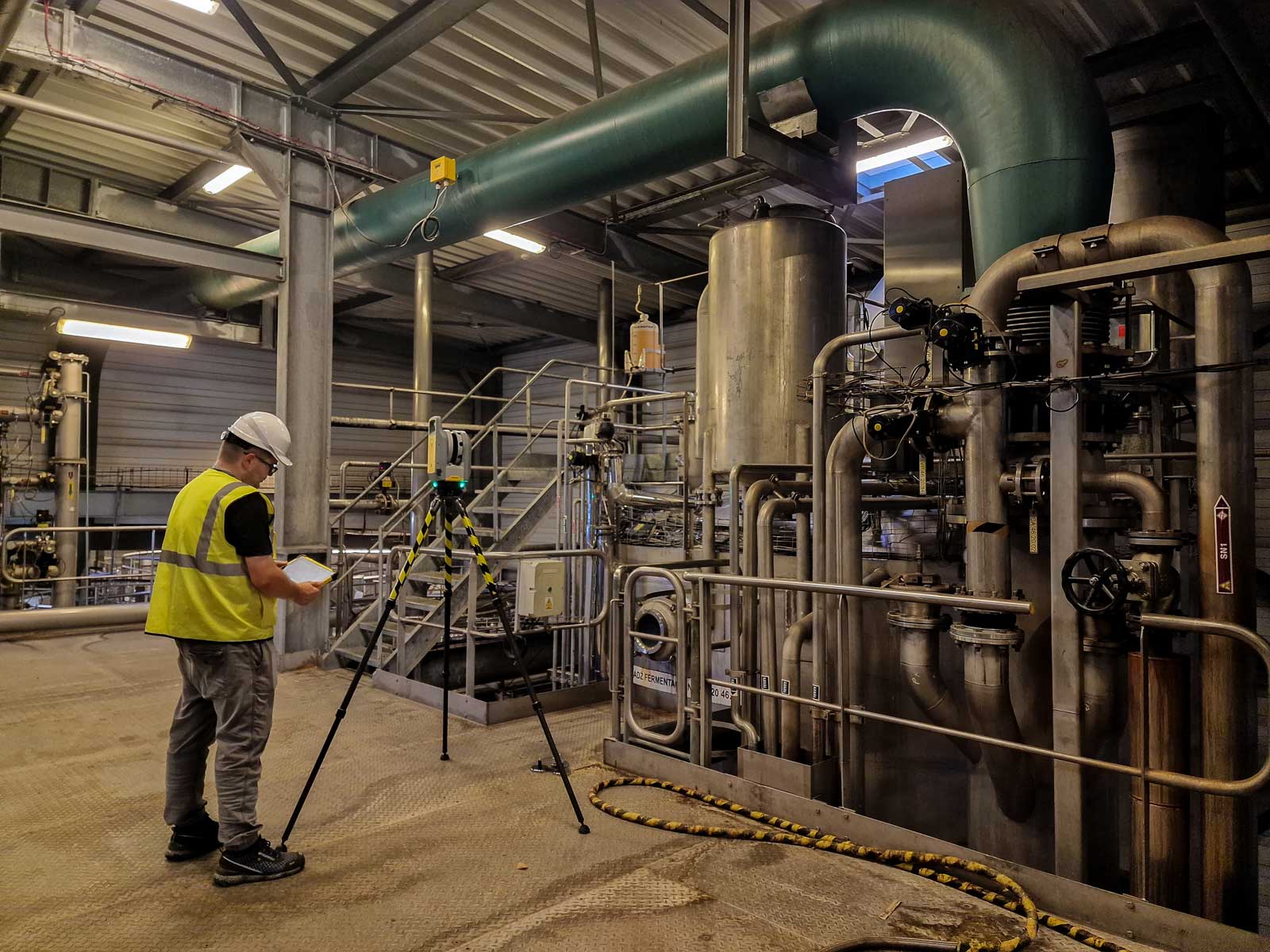
A design is not judged when the dossier is delivered, but during erection. That is where assumptions are verified and unforeseen questions arise, often with a crew waiting for an answer within the hour.
Our site assistance exists for that: following the works, arbitrating with the fitters, and revising the documents in their actually built state. Without that last step, the gap between drawing and installation starts widening again on the very day of restart.
We work for the food and beverage industry, for chemicals and petrochemicals, and for biotechnology. These are not three interchangeable markets: the cleanability requirements of a food line, the resistance constraints of a chemical line and the traceability needs of a biotech process do not lead to the same design arbitrations.
Our engineering has gone out to four continents since 2005. That diversity has a very practical consequence: the applicable code framework is never a tacit assumption for us, it is a question asked at the start — and you receive documents that comply with yours, not with ours.
We do not work on a time-and-materials basis: we commit to a result, not to hours.
We do not deliver a point cloud on its own and present it as a design. A survey is not an engineering study; confusing the two is the surest way of transferring the work back to the client.
We do not make your dossier dependent on software you would not have.
A method is judged on a real situation. Describe yours: we will tell you where we would start, and what we would need to see.
Read more


